After 13 years of work in Guyana by Smithsonian ornithologists surveying far reaching lands of interior Guyana, there were still a number of interesting Guyana records, confirmed by specimens, that we had been unable to verify with modern records. This expedition, undertaken by Brian Schmidt and Christopher Milensky of the Smithsonian Institution and Elford Liverpool of the Guyana Environmental Protection Agency sought to survey one of the few remaining habitats in the country we had not sampled. We chose an area in the Cuyuni/Mazaruni where there is high elevation or ‘alpine’ savannah. This type of habitat is rare in Guyana and is only known to exist in a small part of the country near the Venezuelan border and the Gran Sabana. Our research led us to previous botanical expeditions to Mt. Holitipu just north of the village of Paruima, where this type of high elevation, tepui top, savannah has been documented.
Funding was secured from the Biodiveristy of the Guianas Program and the Division of Birds at the Smithsonian Institution. Approval was granted from the Guyana EPA as well as from the village of Paruima and the expedition took place from 9 February through 1 March 2007. After a charter flight into Paruima on 09 Feb, the bird survey was conducted for 16 days on Mt. Holitipu from 12 Feb through 27 Feb using porters and workers from the village to assist with the transportation of goods to the mountain. We returned to Georgetown by plane on 1 Mar 2007.
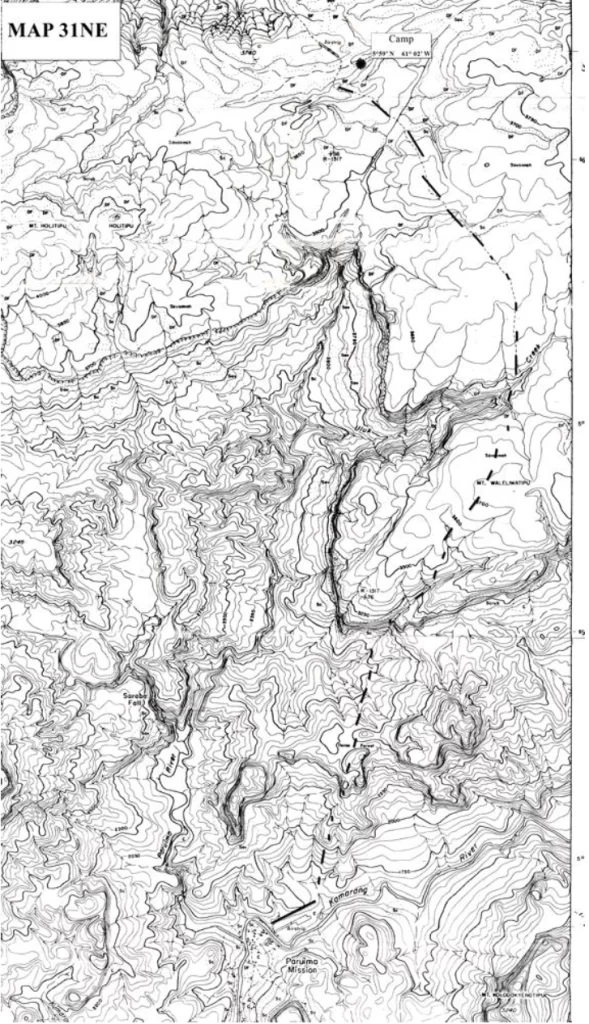
The top of Mt. Holitipu encompasses a very large area of savannah, scrub, gallery forest and ‘bush islands’ ranging from 3500-4000 feet in elevation. We chose to conduct our field work at the northern end of the mountain top near where botanist David Clarke had found many unusual species of plants and where there was known to be a good water source and old camp. (5° 59’ 03”N 61°02’ 43” W) See attached map. There was also some tall gallery forest in the area where we hoped to find a mixture of forest, edge, and savannah birds.
We recorded 100 species of birds on the mountain top (see species list below), of which two were previously unknown to exist in Guyana. One species is the Tawny-headed Swallow (Alopochelidon fucata) and the other is the Pearly-vented Tody-tyrant (Hemitriccus margaritaceiventer). Both species have distributional ranges around Guyana and extend as far south as Argentina and are known to occur in the adjacent savannahs of Venezuela. Based upon vocalization activity and reproductive condition, it appears these birds are breeders in Guyana rather than austral migrants.
In addition to the two new species for Guyana, we confirmed three species that had previously not been recorded by our efforts, although specimen and literature records exist. These species are the Hooded Siskin (Carduelis magellanica), the Black-billed Thrush (Turdus ignobilis), and the Bearded Bellbird (Procnias averano). Also, we found the Rufous-collared Sparrow (Zonotrichia capensis) to be one of the most common birds
in these high savannahs, where we had previously only documented it on a few occasions and always in small numbers.
Not surprisingly, our species list contains several tepui specialists (eg. Thamnophilus insignis, Macroagelaius imthurni, Herpsilochmus roraimae, Caprimulgus whitleyi, Hylophilus sclateri, and Heliodoxa xanthogonys) and many savannah species (eg. Emberizoides herbicola, Ammodramus humeralis, Sporophilia minuta, Synallaxis albescens, and Sturnella magna). Although, at this site we did not find forest capable of supporting species you might normally expect to find in forest at this elevation. Our numbers for Flycatchers, Antbirds, Ovenbirds are particularly low. It is possible these species only occur on the slopes of the tepuis and not in the gallery forest or tepui scrub on the tepui tops. Despite this site having some of the lowest diversity we have come across in Guyana, there are a number of unusual species with very restricted ranges that occur here in great numbers, making this site of very special interest.
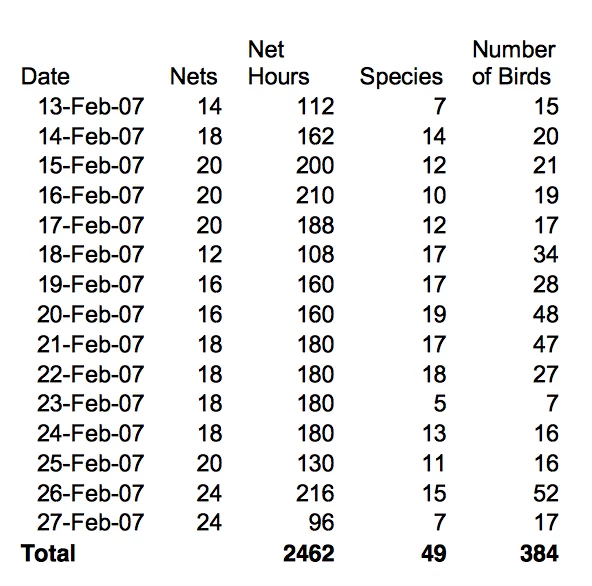
In conjunction with the observational data, our species list includes 49 species of birds caught in our mist net surveys. As computed from the table below, we set an average of 18.4 nets/day for an average of 164 net hours/day. (Nets were generally open from 7am to 5pm each day.) Each day we caught an average of 25.6 birds representing an average of 13 species. Our overall catch rate was 0.156 birds/net hour (or 1.4 birds/net/day). This catch rate, although seemingly low, is fairly comparable with other catch rates we have experienced in Guyana.
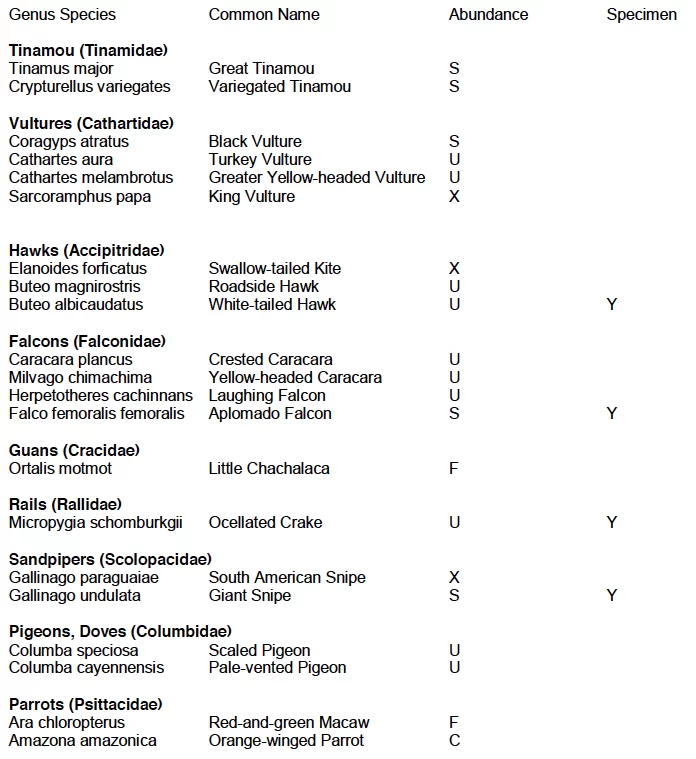
Abundance Codes
C – Common – more than 20 individuals encountered daily
F – Fairly common – 5-20 individuals encountered daily
U – Uncommon – present in small numbers (<5 individuals/day) and not encountered daily
S – Scarce – only occasionally encountered in small numbers
X – notes only one specimen or encounter