
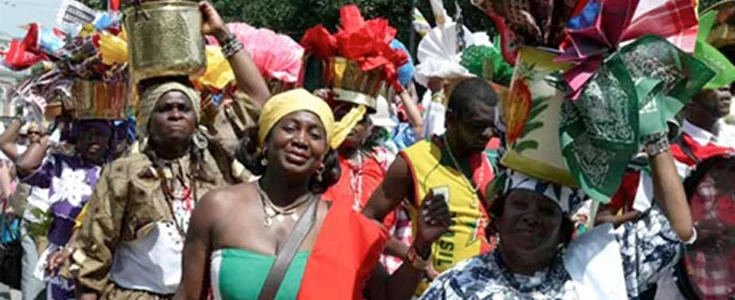
A former Dutch colony with historical ties to colonial slavery indentured servitude, modern Suriname is a curious blend of East and South Asian, Caribbean, Latin American, indigenous, and European influence. Approximately 40 percent of the population is of British Indian descent (the so-called Hindostani), 30 percent is Creole or Afro-Surinamese, 15 percent is of Javanese descent, 10 percent is Maroon (descended from runaway slaves), and there are six thousand to seven thousand Amerindians. Other minorities include Chinese and Lebanese/Syrians.
Following Suriname’s independence in 1975, many Surinamese migrated to the Netherlands. A second wave of migrants relocated to the Netherlands during the 1980s while Suriname was under the military regime of Dési Bouterse. Approximately 350,000 individuals of Surinamese descent live in the Netherlands today.
More than half of Suriname’s half-million inhabitants live in the northern districts of Paramaribo, Wanica and Nickerie. The least populated county is Sipaliwini, which covers most of the nation’s interior.
The official language and medium of instruction is Dutch, but some twenty languages are spoken. The major creole language and lingua franca is Sranantongo, which developed at the plantations, where it was spoken between masters and slaves. Sranantongo is an English-based creole language that has African, Portuguese, and Dutch elements. Attempts to make Sranantongo the official language have met with resistance from the non-Creole population. Other major languages are Sarnami-Hindustani and Surinamese-Javanese. The Chinese are Hakka-speaking. The Maroon languages are all English-based. Eight Amerindian languages are spoken. Sranan developed an overlay of words from Dutch, Portuguese and West African languages. Today Surinamese speak it interchangeably with Dutch, depending on the formality of the setting. Jokes and rap music are often made in Sranan, dismissively called Taki-Taki (derived from the English “talky talky”), but at cocktail parties diplomats struggle with Dutch and get by in English.
A 2008 article in the New York Times explore the tensions, politics, and cultural realities of Suriname’s multilingual society and is worth a quick read.
Paramaribo is multiethnic, but the rest of the coastal population lives in often ethnically divided villages.
Although many marriage partners are of the same ethnic group, mixed marriages do take place in Paramaribo. In traditional Hindostani families in the agricultural districts, parents still select partners for their children. Weddings can be very lavish. Living together without being married is common but is not acceptable to traditional Hindostani, among whom the bride is expected to be a virgin. In the Caribbean family system, female-headed households and the fact that women have children from different partners are accepted. Some women practice serial monogamy; it is more common for men to have several partners simultaneously. Having a mistress (buitenvrouw) is accepted and usually is not shrouded in secrecy. Maroon men often have different wives in different villages; those men do, however, have the responsibility to supply each wife with a hut, a boat, and a cleared plot for subsistence agriculture.
A typical, mainly urban Creole, expression is no span (“Keep cool; don’t worry”), symbolizing the generally relaxed atmosphere. The population has a reputation for being hospitable, and most houses do not have a knocker or a bell. Shoes often are taken off when one goes inside. Guests usually are expected to partake in a meal. A casual conversation is initiated by a handshake, and good friends are greeted with a brasa (hug). Children are expected to respect adults, use the formal form of address when speaking to them, and be silent when adults speak.
Suriname’s art forms derive from several ethnic traditions. Those of Javanese descent, for example, support a number of gamelan (Indonesian orchestra) troupes. Suriname’s Indians and Maroons developed a strong crafts industry, producing colourful textiles, baskets, and wood carvings for export.
Most Surinamese writing is in the Dutch, Sranan, and Hindi languages. Among the country’s leading writers are Albert Helman, whose published works include dozens of volumes of fiction and plays; Martinus Haridat Luchtman, who, under the pen name Shrinivasi, is the author of several books of poems; Astrid Roemer, a popular novelist; and Cynthia McLeod, who has written several historical novels that have earned a wide readership in both Suriname and the Netherlands.
Surinamese music is represented by musical groups such as Fra Fra Bigband, an orchestra from Paramaribo that blends indigenous forms of kaseko (dance music combining Western march, jazz, and calypso), kawina (a type of Creole pop music), and winti (ritual music) to form a distinctly Surinamese brand of Afro-Caribbean jazz. In recent years, Suriname-based groups also have collaborated with Western African musicians, adding talking drums and thumb pianos (lamellaphones) to their instrumentation.