
 Currency
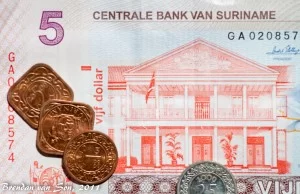
The local currency is the Suriname Dollar (GYD), available in 5, 20, 100, 500 and 1000 SRD notes. One USD is worth 3.25 SRD and one Euro is worth 4.23 SRD (as of Spring 2013). Click here to get an up-to-the-date currency conversion rate.
ATMs
You will not be able to use your credit or ATM card outside Paramaribo. As a convenience, your driver can take you to one of a handful of ATMs in town but it may not be operational or accept your card. An ATM in the arrival hall of Pengel International Airport is usually operational, although it seems to work better with cards issued in Europe than in North America. Establishments that accept credit cards may pass along the 2-4% bank fee associated with the transaction. It is best to inquire in advance about such fees to avoid unpleasant surprises.
Cash
There are limited shopping opportunities in the jungle. As a rough guide 300 SRD per traveler is likely to be more than enough to cover incidental costs, tips, alcoholic beverages and occasional souvenir shopping opportunities outside the capital city on a 7-10 day venture. Expect to spend more if you wish to undertake special excursions, especially at places like Bergendal where some Activity Center programmes have extra costs. Bergendal does accept credit cards most of the time, depending on the status of their equipment and phone line.
Ask your local guides and hosts in Paramaribo for guidance.
You may be able to exchange modest amounts of cash at the front desk of your hotel.
Travellers Cheques
These have limited practical use in Suriname, as only a few hotels and cambio desks accept them. ATMs are far more convenient, but TC’s do have some value as an emergency backup funding source. Keep in mind there are no banking facilities of any sort outside of Paramaribo.
Tipping
Suriname does not have a tradition of tips, and they are not expected. Of course, they are certainly appreciated if you are happy with the service. As a guide, a 10% tip is adequate. In the interior it is suggested that tips are given to the manager or village captain for equal distribution amongst all involved in providing hospitality and service.
While in Suriname’s interior, if you are inclined to personally offer a tip for service above and beyond expectations it should be given in SRD whenever possible as there are no facilities for exchanging foreign currency outside Paramaribo.
Gifts
Though we all feel the spirit of generosity while traveling, giving candy or money to children can lead to begging and unhealthy behavior. If you wish to do something for the children you meet, we suggest giving school supplies such as pencils, pens, crayons, erasers, and notebooks. Books are a great idea too, however be thoughtful about cultural and contextual considerations (The colorful and engaging storybook “Joey Goes to the Mall to Buy $200 Nike Shoes” may not be the best selection for an 8 year old in an Saramaccan Village, for example!)
If you are feeling more generous, we encourage you to bring along extra equipment like good-quality binoculars, scopes, tripods, wildlife identification guides, LED headlamps and flashights, sound recorders, GPS equipment, walkie talkies, or other gear that might be useful in nature guiding. Contact our operations team for specific suggestions.
It is immensely easier to bring gifts with you to personally deliver during your visit than to ship them to Suriname afterwards.
Shopping
Paramaribo has a lively shopping scene, especially in the town centre near Hotel Krasnipolsky and Spanhoek, but most items for sale are of a utilitarian nature. If you are interested in shopping for authentic arts and crafts or items of a particular nature, please talk to your guide who can suggest local vendors with a good reputation. Suriname does not have a ‘tout’ tradition where referring guides receive back-room payments, so you can feel comfortable taking your guides’ advice.
A few lodges have small souvenir counters selling locally-produced items such as raw honey, t-shirts, bags, and hats, gift cards, sculptures, wood carvings, and Maroon-style cloth.
Bargaining is not part of Surinamese culture.
If you do find an opportunity to shop in Suriname, our usual recommendations apply:
- Carry your purchases home with you. Shipping your items is unreliable and your goods may arrive later than anticipated, damaged or even not at all.
- Never buy anything “valuable” or “old” unless you will still like it just as much if it does not turn out to be as valuable or old as you were told.
- Watch the item you have bought being wrapped, and check it is that same package that is given to you.
- Carefully review the receipt or credit card slip before you sign it and leave the shop, verifying the amount paid and the item bought. Keep all of your sales receipts as you may need to show them to Customs officials.
- Avoid buying gems and precious metals unless you have a high degree of confidence in your ability to assess the quality and purity of the merchandise on offer. Also consider the devastating environmental impact of the mining sector when considering shopping for precious metals and stones. Illegal and ‘artisanal’ mining in the Guianas is considered the largest and most rampant source of environmental degredation these days, and buying precious metals or stones in local markets only serves to feed a system that is slowly and irreparably harming the land and causing widespread grief for indigenous communities impacted by fouled water and food supplies.
Customs Considerations
To avoid disappointment, aggravation, or – worst of all – fines, it’s wise to know what is and isn’t allowed back into your home country. US Travelers should carefully read the Know Before You Go brochure published by the U.S. Customs Service, while residents of Great Britain should review Home Office Border Agency guidelines here. Residents of other countries should inquire with their domestic immigration authorities.
Remember that purchases from duty-free shops are usually not exempt from allowances for alcohol or other imported items.
Giving Something Back
Because it can be difficult to send needed items to a distant place after your trip, it may be easier for you to bring along some gifts to share along the way. Ask to see the ‘wish lists’ we’ve collected from various villages you’ll visit on your itinerary. Of course, traveling with a bottle or two of rum to share never hurts either! No, really.