Suriname, country located on the northern coast of South America. Suriname is one of the smallest countries in South America, yet its population is one of the most ethnically diverse in the region. Its economy is dependent on its extensive supply of natural resources, most notably bauxite, of which it is one of the top producers in the world. The southern four-fifths of the country is almost entirely covered with pristine tropical rainforest. Formerly known as Dutch Guiana, Suriname was a plantation colony of the Netherlands that gained its independence on Nov. 25, 1975. From 1980 to 1987 the country was governed by a succession of military regimes. A new civilian constitution was approved in 1987. Another military coup took place in 1990, but the country returned to civilian rule the following year. The capital, Paramaribo, lies 9 miles (15 km) from the Atlantic Ocean on the Suriname River.
The narrow coastal zone, some 226 miles (364 km) long, consists of sandbanks and mudbanks deposited by the southern equatorial currents from the area surrounding the mouth of the Amazon River (located to the east of Suriname, in Brazil). South of the mudbanks begins the New Coastal Plain, also formed from sand and clay from the mouth of the Amazon. The region, covering some 6,600 square miles (17,000 square km), consists of swampland. The soil of the swamps is clay, in which a great deal of peat has formed. The region is traversed by sandy ridges that run parallel to the coast.
South of the New Coastal Plain is the Old Coastal Plain, which covers some 1,550 square miles (4,000 square km). It consists largely of fine clays and sands and contains a variety of topographies, including old ridges, clay flats, and swamps.
South of the Old Coastal Plain is the Zanderij formation, a 40-mile- (64-km-) wide landscape of rolling hills. This formation rests on bleached sand sediments, which are rich in quartz. Most of the region is covered by tropical rainforest, but swamps and areas of savanna grassland are also found.
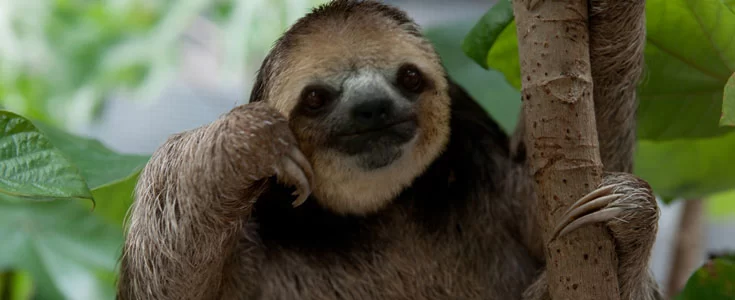
Those Sloths
In 2013, a large construction project cleared hundreds of acres of forest on the outskirts of Paramaribo… leaving a large population of sloths homeless. A Paramaribo conservationist adopted the sloths (and later relocated most of them to suitable natural habitats) resulting in a tidal wave of too-cute-to-be-true footage. Here, Conservation International peers briefly into the faces of some highly odd – and endearing – creatures that call Suriname home.