
This year’s trip exceeded our wildest expectations. Firstly, all flights were on time and the luggage was received safely at all our destinations. Secondly, the weather was much better than last year when it was unseasonably wet. This time we experienced heavy tropical downpours whilst in the rainforest, but that’s to be expected, and in the ‘dry season’ even these don’t last long.
One of our aims was to stay longer at the Iwokrama Rainforest Research Station situated about half-way down Guyana amid pristine rainforest. Having missed our outward flight last year we could only stay there one night, so had opted for three nights this trip. This certainly paid off, as you will see later.
We arrived at our hotel in Georgetown just before midnight, so were given the next day free to recover. The manager of Wilderness Explorers, our ground agents in Guyana, welcomed us at the hotel the following morning and gave us a lift to the Botanical Gardens where we spent a few hours acclimatising and getting our eyes attuned to watching beautiful tropical birds which included Red-capped Cardinal, Yellow-chinned Spinetail, Pied Water-Tyrant, Common Tody- Flycatcher, Striated Heron and Snail Kite. In the lake we saw several manatees or sea-cows, which looked like semi-submerged grey rocks until they came up for air. Afterwards we made our way back to the hotel on foot.
The next day we were booked on a flight down to Rock View Lodge in the southern savannahs. As the flight was full, they had to juggle the order of where we would land first. Although Rock View is actually nearest to Georgetown, we flew all the way down to the Brazilian border at Lethem, then back to Karanambu Ranch (where Diane McTurk fosters orphaned Giant River Otters) and eventually reached Rock View. The whole trip took around one-and-three quarter hours. We were allowed off the plane in Lethem and on re-boarding noticed that our rucksacks had been removed. The man responsible had to run after the baggage lorry to retrieve them, fortunately before it set off for the town!
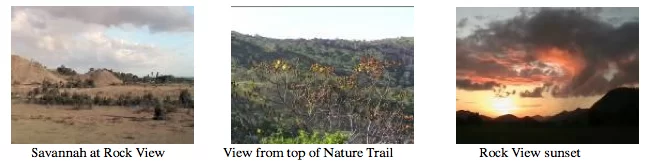
At Rock View we were welcomed by the owner, Colin Edwards, and were shown to our well- appointed room by Val who is responsible for looking after visitors. Rock View is still a working cattle ranch situated in the grasslands that spread out from the forested foothills of the Pakaraima Mountains in the south of the country. We spent two nights here and made several visits to the nature trail that climbs a wooded hillside nearby. On reaching the highest point, there are splendid views across open savannah to distant mountains. Birds seen in the area included Buff-necked Ibis, Amazonian Troupial, Summer Tanager, Vermillion Flycatcher, Green- tailed Jacamar, Black Curassow, Blue-crowned Motmot, Brown-throated Parakeet and Little Chachalaca.
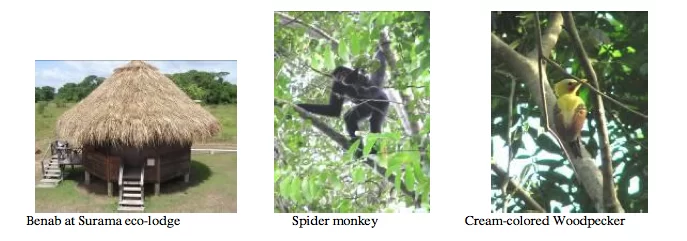
We next moved to the Amerindian village of Surama for two nights. We had stayed at the new eco-lodge last year and were delighted to meet friends here again. Surama is a Macushi village and the local people are placid and most welcoming. We were able to walk three miles to the Burro Burro River and then to drift along in a dugout canoe under the warm afternoon sun, hearing only birdsong and the occasional dip of the paddle. You feel like (and probably are) the
only humans for miles around. In the evening we were invited to a cultural show staged by the villagers. Some of the children performed songs and dances in local costume and we, along with other guests, introduced ourselves and explained where we were from and why we had returned. This event took place around a bonfire on the school playing-field during a total lunar eclipse when the moon turned blood-red. It was the first of several rather surreal experiences. Birds seen around Surama included Red-and-Green Macaw, Paradise and Great Jacamar, Cayenne Jay, Golden-headed Manakin, Cream-colored Woodpecker, Red-breasted Blackbird, Grassland Sparrow and Savannah Hawk.
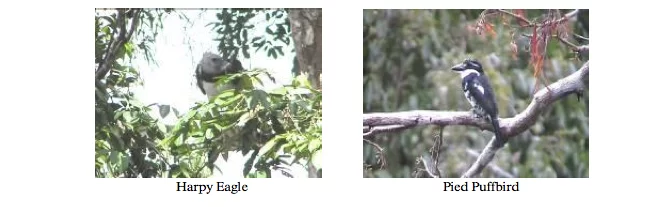
The next morning we were due to leave at 5:30am but our vehicle arrived leaking automatic transmission fluid, so we had to wait for another vehicle to be found. Fortunately a large group of Guyanese trainee eco-guides was in the village and we were able to ‘borrow’ their minibus. We were on our way to the Iwokrama Rainforest Research Station via the famous Canopy Walkway. We had heard, however, that on the way there was a nest-site of the rare Guianan Cock of the Rock, just a ten-minute walk from the road. We duly stopped there and were rewarded with views of two males in the forest (bright orange birds about the size of small chickens) and two females on nests among the rocks. Continuing to the Canopy Walkway (CWW) we arrived around 9:30 and had a late breakfast before heading into the rainforest. At the CWW itself there are four platforms, each constructed around a large forest tree, linked by narrow aluminium walkways. Only one person is allowed to cross between platforms at a time, so our guide (Archer Moses) went first, followed by Sylvia and then me. When the guide arrived near the second platform he seemed very reluctant to move off the walkway, but eventually he did and Sylvia crossed over. She then did the same and there was much whispering and signalling to keep quiet. When I eventually arrived, all became clear – there was one of the rarest birds in Guyana perched in a huge tree just to the right of the platform. It was a Harpy Eagle, the largest raptor in the world, capable of plucking monkeys out of trees! The bird guide for Venezuela describes it as “rarely encountered”; in fact our guide had only seen one twice before. After a short time the eagle flew out from the tree, across the front of where we stood and alighted in another tree off to our left. Such a good sighting eclipsed everything else we were likely to see, or so we thought until, on the way back to base camp, we spotted a Puma crossing the path 50 yards ahead of us. Again both we and the guide couldn’t believe our luck, as we watched it saunter off down a side trail and then disappear into the undergrowth. This had certainly been our lucky day – if we had left on time at 5:30, chances are we would not have seen either the eagle or the puma.
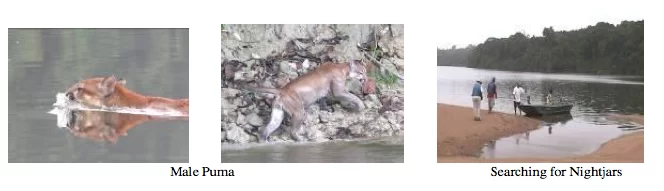
Our luck held the next day too. The Iwokrama Field Station is situated next to the largest river in Guyana, the Essequibo. There is no road and all transportation is made by boat, so we were due for a morning’s bird-watching excursion down the river. Having set off, just a few miles downstream Lewis, the guide, suddenly spotted what he thought was a Jaguar swimming across the river but, checking through binoculars, it was clearly another Puma. Our ‘captain’ managed to steer the boat parallel to the animal, but at a reasonable distance, giving us brilliant views as the animal completed its crossing. When it arrived at the bank, which was at least twelve feet high, it took one look back at us and then leapt to the top with one almighty spring and disappeared into the forest. We had been treated to the sight of a fully-grown male Puma in its prime, and we have photographs to prove it! Later that morning we found some roosting Ladder-tailed and Blackish Nightjars on one of the numerous beaches that line the river.
The next day we travelled further downstream to Stanley Lake, which is an offshoot of the main river. Here we picked up some new birds, including Capped Heron, Large-billed Tern, Rufescent Tiger-Heron, Black Skimmer and the elusive Sungrebe. We also encountered a huge Aparaima fish which protects its offspring by swimming just underneath them near the surface. When the parent comes up for air, the young fish, which can number more than a hundred, can be seen flapping about on the surface. On the way back to Iwokrama we had a late picnic lunch on the river bank and after setting off again were caught in a tropical downpour. However, capes are always readily available, so we didn’t get too wet.
The next morning we bade farewell to Iwokrama, crossed the river and were driven overland to Shanklands Lodge, many miles downstream on the banks of the Essequibo River. Bernard, the manager of Shanklands, met us halfway and the last part of the journey was made on a narrow, rutted and muddy track through thick forest. On three occasions Bernard had to cut a way through, where fallen trees blocked our progress. We arrived around 4p.m. after a long but interesting drive. On the way we saw Grey-winged Trumpeter, Great Tinamou, Peccary, Agouti and Deer.
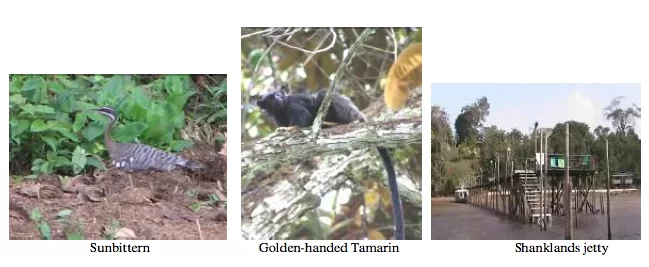
Shanklands is a paradise for birdwatchers. Our birding guide here was Leonard Felix whom we had met in 2006. With his help we saw Sunbittern, Black-necked and Green Aracari, White- throated Toucan, Laughing Falcon, Plumbeous Kite, Bat Falcon, Yellow-rumped and Red- rumped Cacique, Red-bellied and Red-shouldered Macaw, Golden-winged Parakeet, Purple- throated Fruitcrow, Silver-beaked and TurquoiseTanager, and Yellow-crowned Tyrannulet.
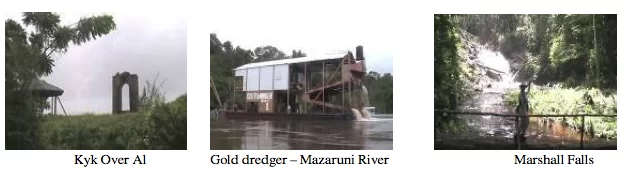
On the morning of the second day we had a boat trip upriver to Kyk Over Al, where a solitary arch is all that remains of the fort built by the Dutch settlers on a small island in the river. We then continued up the Mazaruni River, passing a granite mining company and a commercial gold dredger spewing processed waste water back into the river. We continued over several exciting series of rapids and eventually drew into the bank, miles from anywhere. A ten minute trek through the forest brought us to the Marshall Falls – nowhere near as breathtaking as the magnificent Kaieteur Falls that we visited last year – but in a beautiful setting nonetheless. The crystal clear water below the falls passes over rocks stained wine-red. To get the best views, we had to cross the river on a huge log, but fortunately a wooden handrail had been attached along one side, so we were able to traverse it without too much difficulty. We returned to Shanklands passing the ‘wild west’ town of Bartica on the way. After lunch we bade farewell to the staff and headed off down river for the 11⁄2 hour journey to Parika. This proved quite exciting as there was a northerly head wind which made the water very choppy and stirred up the sand in the shallows. This resulted in the engine cutting out several times and we were forced into deeper, clearer but rougher water. Nevertheless, we made it in one piece and were met at the jetty by Zaman, who drove us back to the Cara Lodge for our last night in Guyana.
In the morning we were taken to the international airport for our flight to Trinidad, where we stayed four nights at a nature centre in the Arima Valley – but that’s another story.