

A group of seven representatives from birding tour companies from throughout the world (one of them being myself, Chris Lotz from Birding Ecotours), and two journalists from UK birding publications, were hosted by the GTA (Guyana Tourism Authority), the GTIS (Guyana Trade and Investment Support) and USAID (United States Agency for International Development), on a tour aimed at familiarizing us with what Guyana has to offer in terms of:
1) birds (and other wildlife), and
2) tourism infrastructure such as lodges, local birding guides and transport.
The tour was organized by Judy Karwacki from Small Planet Consulting in Canada, using Wilderness Explorers as the ground operator in Guyana.
The trip was a fantastic success, exceeding expectations. Most importantly, we found superb birds – the group checklist of 376 species can be viewed at http://www.guyanabirding.com/trellis/Checklists, and included the likes of Guianan Cock-of-the-Rock, Guianan Red Cotinga, Guianan Puffbird, Crimson Fruitcrow, Blood-colored Woodpecker, Capuchinbird and a host of other exciting species quite localized and difficult to find in other parts of South America. In addition, there are excellent sites for Jaguar, Giant Anteater and other spectacular mammals which our clients usually enjoy as a by-product of our marked focus on birding. And, we found the infrastructure adequate to allow us to arrange tours for our clients to this remote wilderness, huge tracts of which are still covered by pristine forest.
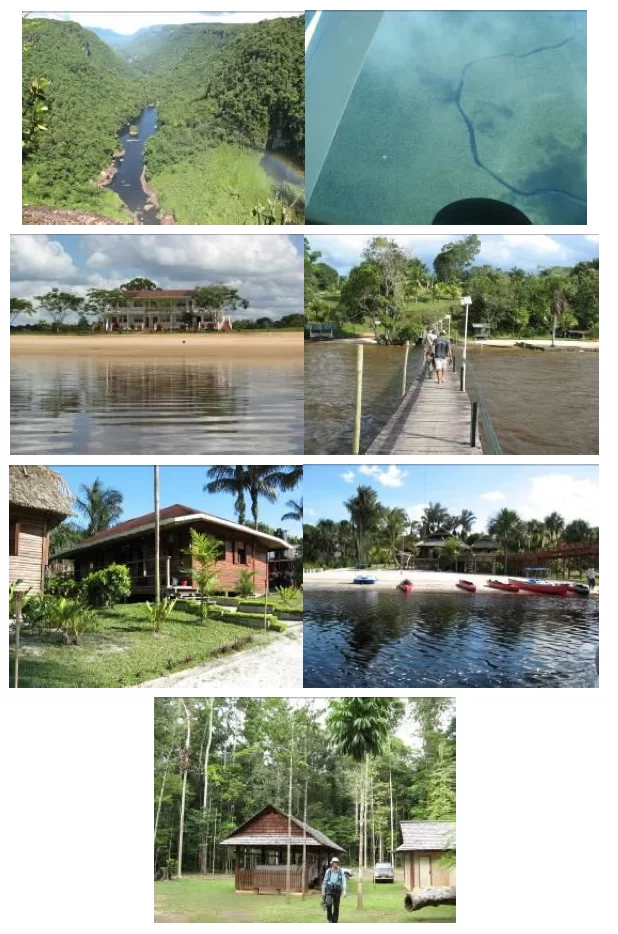
Excitingly, Guyana is covered by seemingly endless tracts of untouched wilderness. But, in the middle of the jungle, it is possible to find interesting lodges ranging from luxurious to rustic. Since Guyana is poorly known, we hardly knew what birds to expect at and between these lodges.
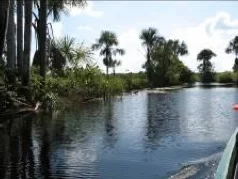
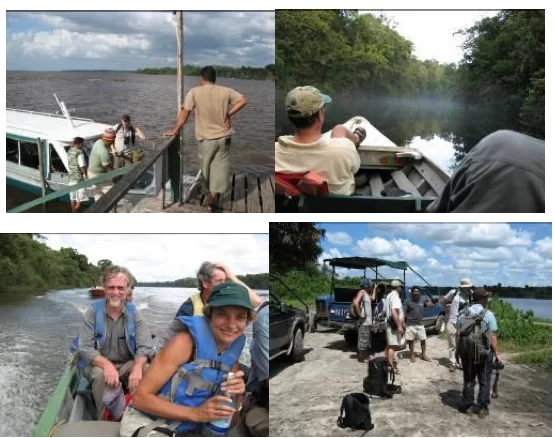 Boat may be the most practical means of getting around Guyana. A boat trip along a creek can also be excellent for birding (as is walking the good network of trails around many of the lodges)
 Although roads are not always great, they do open up some excellent parts of Guyana to birders. Walking along this particular road, we found tons of cotingas, toucans, jacamars, barbets and other magnificent birds, some of them while waiting for the vehicle pictured to be removed.
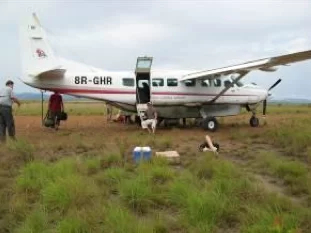 With birders who want to save time, flights in light aircraft are always a possibility
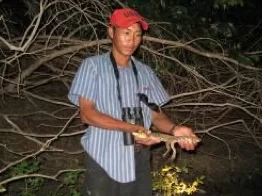 There are quite a number of local birding guides who have been trained in Guyana. Several of these people have unbelievably sharp ears and eyesight, and are very knowledgeable about the birds (including calls) in their areas.
There is great potential for some of these guides to earn good income from showing people birds, especially if more foreign birders learn about the spectacular potential of birding in Guyana.
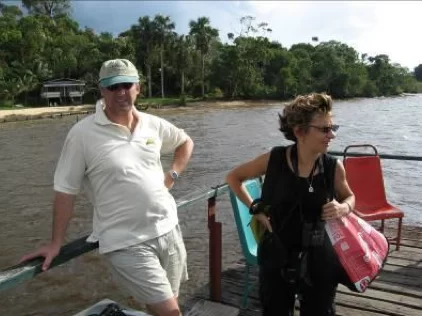 Tony Thorne operates Wilderness Explorers, an eco-tourism ground operator that makes any tour through Guyana run smoothly. We will use them to help us set up birding tours there. On the right is Judy Karwacki of Small Planet Consulting – she was instrumental in arranging our birding familiarization tour,
and is doing a fantastic job at promoting Guyana’s SUPERB birding potential.
Guyana is the only English-speaking country in South America, making it an easy place to get around (and understand what is happening!). We found locals not only proficient in English, but also EXTREMELY friendly, hospitable and pleasant.
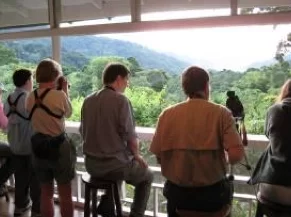 Many international flights to Guyana travel via Trinidad. On this Caribbean Island there are some marvellous birding sites, such as Asa Wright (pictured above) where motmots, hummingbirds, honeycreepers, tanagers and other stunning birds come to the feeders while you sit on the veranda sipping tea. And, lekking manakins, toucans, trogons, and other species unlikely to be attracted to feeders can be found by walking the surrounding forest trails. It is well worth spending a day or more birding in Trinidad en route to Guyana.
The cricket world cup is being hosted by the West Indies, including Trinidad and Guyana, in 2007. Why not combine a visit to watch a game or two of cricket, with some neo-tropical birding?
The text of this daily report contains much of what Judy Karwacki wrote while we were on tour, but I have added photos and some of my own text.
Day 1, Nov 17: We arrived at the airport in Georgetown, Guyana, and cleared customs smoothly and quickly. After a warm welcome by Judy Karwacki (of Small Planet Consulting) and Tony Thorne (of Wilderness Explorers) who met us at the airport, we went directly to the Garden of Eden. This is a nice birding site within the fairly small but interesting city of Georgetown. Here, we found some excellent birds, such as Azure Gallinule, Yellow-chinned Spinetail, Wing-barred Seed-eater and Little Cuckoo, to name but a few. Andy Narine, president of the Guyana Tropical Birds Society and owner of Guyana Feather Friends, guided us here, as well as at the
Botanic Gardens the following morning. We spent the night at a comfortable hotel, the Grand Coastal Inn.
Georgetown has some intriguing architecture, is now below sea level (with a sea wall protecting it) and most of the houses are built on stilts. I’ve never seen a town anything like it – it’s a fascinating place to visit.
Day 2, Nov 18: We birded the Botanic Gardens in Georgetown for a couple of hours, starting at 5:30 am (we generally started birding around this time, when it got light). We managed to find three Blood-colored Woodpeckers in the same tree, together with loads of other excellent but more widespread birds such as Limpkin, Black-capped Danacobius, Wattled Jacana, various parrot species, etc. After having breakfast and viewing the rooms and amenities at the Roraima Residence Inn, we headed to Parika by bus where we boarded a speed boat for a river journey. Our first stop was the Baganara Island Resort, where we began with a site inspection and a tour of the resort’s birding trails. Next, Aboul Bah, Manager of Evergreen Adventures, hosted the group for a scrumptious lunch on Baganara House’s expansive verandah overlooking the scenic and enormous Essequibo River.
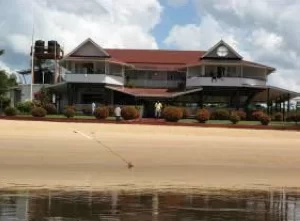 Baganara, a comfortable lodge on the banks of the mighty Essequibo River
We then re-boarded our boat and continued on to Shanklands Rainforest Resort, where the group split into two for separate afternoon birding experiences. Half the group walked the fairly extensive network of roads and trails that wind through the mature tropical forest surrounding Shanklands, searching for the more than 20 species of antbirds and other forest birds that inhabit the area. The other half of the group boarded a small boat and drifted down Macouria Creek scouring the forest along the banks and the sky with our binoculars. A highlight was seeing clouds of Red-bellied Macaws noisily feeding on Moriche Palm fruit. In
the evening we enjoyed a mouth-watering welcome BBQ hosted by Shanklands’ owners Max and Joanne Jardim and manager, Bernard Lee Yong (food throughout the tour was excellent and in large volumes – we were truly spoilt).
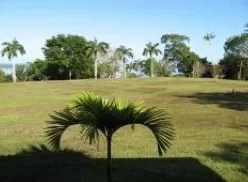 The lovely garden at Shanklands, off which one can walk the forest trails or do creek birding by boat
Day 3, Nov 19: Another early morning started with birding Shanklands’ expansive grounds and forest trails with budding birding guide Felix Leonard. Among many other species at Shanklands, we viewed Crested Oropendula, Yellow-rumped Cacique, and Moriche Oriole. Real highlights were Black-necked Aracari and the elusive Painted Tody-flycatcher, and we also got close views of a Golden-handed Tamarin. Following a delicious breakfast, we hopped aboard open-backed jeeps and travelled through tall tropical and lower sand-belt forests, finding Black Curassow and Gray-winged Trumpeter along the way. We then transferred to a boat and journeyed on the Demerara River and into the black waters of the meandering Kamuni Creek, where we were fortunate enough to see both Squirrel Monkey and Bearded Saki. The overhanging jungle vegetation gave way to wide open savannahs, and we eventually reached picturesque Arrowpoint Nature Resort where we were warmly greeted by owners Gerry and Debbie Gouveia. After lunch, we went birding on trails in the Moriche Palm and secondary sand-belt forest behind the resort. Dinner was served on the beach under the stars in front of a blazing bonfire. After dinner we went on a jungle walk, where we found a Rufous Nightjar and searched for potoos, other night birds and forest animals.
 Here at Arrowpoint, we were to get marvellous views of Crimson-topaz Hummingbird and many other star birds
Large, highly vocal and often frequenting open clearings, Tim Earls from the Travelling Naturalist are generally easier to locate than other representatives of Guyana’s fauna
Day 4, Nov 20: As dawn was breaking, we set out by rowboat and kayaks for a peaceful morning birding session on the stretches of water and forest upstream from Arrowpoint. Our bird-list grew as we encountered several new tanager species, Least Bittern, trogons, Green Ibis and Black-headed Antbird. We also saw quite a number of hummingbirds, the highlights being Green-tailed Goldenthroat and the brilliant Crimson Topaz. After an appetizing traditional Guyanese breakfast, we boarded a charter flight and flew over hundreds of miles of unbroken tropical rainforest to land at Kaieteur Falls National Park.
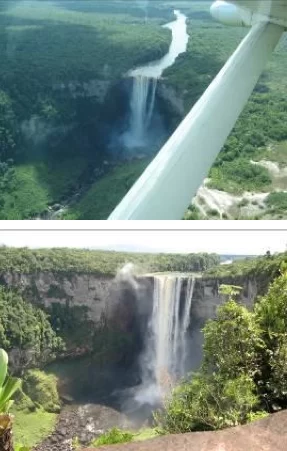 The impressive Kaieteur Falls, around which Guinian Cock-of-the-Rock are quite easily found.
We saw some excellent birds, viewing not only the astonishingly colourful Guianan Cock-of-the-Rock and lots of White-chinned and White-tipped Swifts, but we were also lucky enough to see the rare Orange-breasted Falcon swooping over the gorge. And, we scoped a Sunbittern sitting on a rock in the gorge.
After spending a couple of hours at the falls, we then continued on our charter flight. After a while, the unbroken forest canopy below us suddenly gave way to a huge grassy savannah, the Rupununi. We landed in an AmerIndian village in the middle of this savannah – Annai, from where we continued by road.
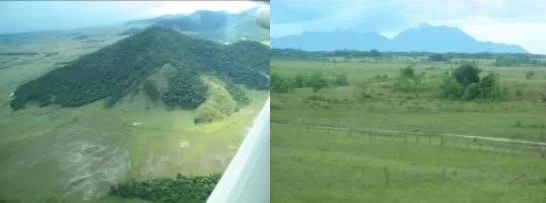
The Rupununi Savannah sprawls over a fairly large area of central Guyana. Here, unique wildlife lurks – one species relatively easily found in Guyana is Red Siskin, although we did not have time to visit its areas during this brief tour
We left the savannah again (to return a few days later), after which it still took us several hours to reach our final destination, the AmerIndian community of Surama, because the roadside birding was so brilliant. A couple of the MANY highlights were Spotted Puffbird and Finch’s Euphonia. We also saw many other wonderful species including Purple-throated Fruitcrows, Painted Parakeets, and Blue-headed and Dusky Parrots.
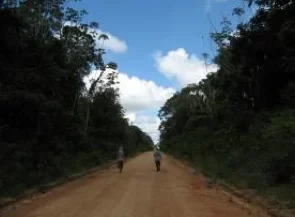
Birding along the road was extremely productive
When we finally reached the lodge at Surama, the head of the Tourism Committee, Sydney Allicock, and the Surama community treated us to a dinner of delectable traditional local foods, which many participants said was the best meal yet. We then turned in to enjoy a comfortable sleep in “benabs” or thatched sleeping shelters.
Day 5, Nov 21: We departed at dawn for a walk through the forest with Surama guide Milner Captain and Ron Allicock, a guide from Iwokrama International Centre. Among the many species viewed were Brown-throated Parakeet, Golden-headed Manakin, Todd’s Antwren, Rufous-throated Antbird and Red-and-Green Macaw. After breakfast, we departed by 4×4 for a journey into the marvellous Iwokrama rainforest. Again, the sheer diversity of Guyana birdlife waylaid us as we stopped repeatedly for amazing birding opportunities. Highlight species we encountered included Great Jacamar, Black Aracari, Guianan Red Cotinga and a flock of Gray- winged Trumpeters. One group member was lucky enough to see an Ocelot! Eventually, we reached the Essequibo River (again) and the Iwokrama Field Station.
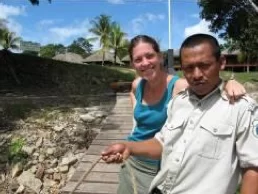 It was nearby the Iwokrama Field Station (above) on the Essequibo River where a couple of us spotted a Jaguar while walking a trail!
The group split into two, with half of the participants heading out on the Screaming Piha Trail with guide Ron Allicock. The other half travelled by boat to Turtle Mountain to explore the trail and visit Turtle Ponds accompanied by local guide Dexter Torris. A couple of group members saw a Jaguar, and also obtained our first good views of Red Howler and Black Spider Monkeys. Finally, after dark, we set out by boat on the river with a spotlight and saw Black Curassow, Capped Heron, Tri- coloured Heron, Pauraque and other interesting birds, plus Black Caiman.
Day 6, Nov 22: We enjoyed tropical fruit and juices gazing over the mighty Essequibo River from the Iwokrama Field Station before breaking into two groups for the morning activities led by Iwokrama guides Ron Allicock and Dexter Torris and accompanying guide Justin DeFreitas (Justin is an incredibly knowledgeable guide who joined us for the entire tour). Some of the group embarked in a boat for birding on the river and spotted Green-and-rufous Kingfisher, Semi-palmated Plover and the extremely neat Pied Plover, Black Skimmer, Large-billed Tern, and many Blue- headed and Orange-winged Parrots along with Red-and-green Macaw. The rest of us set out to explore the trails around the Iwokrama Field Station, encountering Great Jacamar, Golden-sided Euphonia, Violaceous Trogon, Hawk-headed Parrot and Festive Parrot, and as usual a host of others. We were also fortunate enough to see a Spotted Antpitta, an elusive skulker of the forest floor. But, the highlight of the morning to several of us was an Army Ant swarm, which drew in the stunningly spectacular White-plumed Antbird, plus the attractive Rufous-throated Antbird, Buff- throated Woodcreeper and numerous others. After breakfast we headed off in 4×4’s to travel to the Iwokrama Canopy Walkway, a series of suspension bridges and decks up to 30 meters above the Iwokrama Rainforest floor and 154 meters in length.
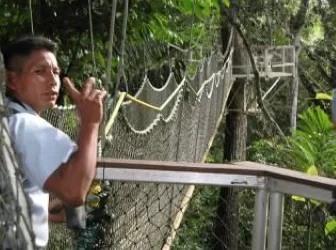 The Iwokrama Canopy Walkway offered us rich pickings such as Guinian Puffbird, Guinian Toucanet, several awesome cotingas, and tons more, even though our visit was brief
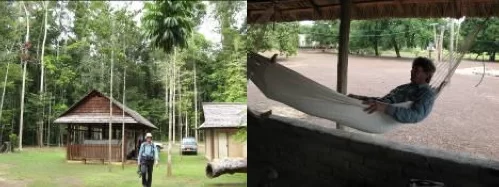
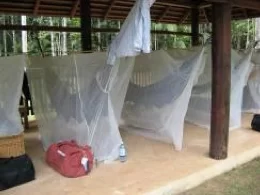 Accommodation at the canopy walkway itself is rustic (at the Atta Rainforest Camp Lodge), but there are other pretty comfortable options not too far away, such as at Rock View Lodge, if sleeping in hammocks is not your cup of tea
The amazing diversity of birdlife found along the highway once again made it difficult (quite typical in Guyana) for us to get to our destination, as we stopped every kilometer or two to view Copper-tailed Hummingbird, Spangled Cotinga, White- crowned Manakin, Yellow-tufted Woodpecker, Purple Honeycreeper, Marail Guan, Black Currasow, King Vulture, Green Oropendola, Painted Parakeet, Black-headed Parrot, Paradise Jacamar, Great Black Hawk, Double-toothed Kite, and Rufous- crowned Elanea, among a plethora of other species. At the Canopy Walkway we were greeted by guides Archer Moses and Dominic Harris. We enjoyed another elating birding experience from the canopy towers as we saw Todd’s Antwren, Sooty-headed Tyrannulet, Waved Woodpecker, Long-billed Starthroat, Dusky Purple-tuft, Guianan Red Cotinga (again), Pompadour Cotinga, Rufous-throated Sapphire and Black- throated Hummingbird, Guianan Toucanet, Spot-tailed Antwren and Guianan Puffbird. We also saw Black Spider Monkeys. After dark, we headed out for a night drive on the Georgetown-Letham road in search of Jaguars (common but elusive in the area). But, all we could find this evening were Spectacled Owl, a probable Mottled Owl, Red-and-Green Macaw, and Rufous Nightjar, along with a Nine-banded Armadillo in the trees and on the road. All in all it was a marvellous birding day, our best one yet by far. The group was exhausted but exuberant as we turned in for the night, cocooned in hammocks at Atta Rainforest Camp Lodge just below the canopy walkway. Iwokrama (including the canopy walkway, the international centre, parts accessed along the highway, etc.), must be one of the most spectacular birding sites on earth.
Day 7, Nov 23: This morning we welcomed the dawn chorus from the Iwokrama Canopy Walkway and explored the surrounding trails accompanied by our local guides. After breakfast, five members of the group were transferred by 4×4 to Wowetta, a Macushi AmerIndian community. Several of us trekked on a well- maintained trail to a lek of Guianan Cock-of-the–Rocks with our Woweta guide, Huxley Moses. It was truly incredible to view numerous brilliantly colored males preparing the lek grounds for the mating season, which begins in January. We also
saw two females in their natural habitat perched in trees for perfect viewing. It was gratifying to participate in this six hour tour, a community based project managed by the Woweta community. Those who did not take part in the Cock-of-the-Rock Trail trek, spent their time birding the road between the Canopy Walkway and Woweta and the virgin rainforest on the Cock-of-the-Rock trail, and found remarkable birds such as Crimson Fruitcrow. In the late afternoon, we journeyed back to Annai, the Rupununi’s northernmost community. Upon arrival at Rock View Lodge, we were greeted by owner Colin Edwards. In the evening, we enjoyed a Brazilian-style BBQ dinner and a quick dip in Rock View’s small but lovely swimming pool before turning in for a well-deserved night’s rest. Among the special and rare birds we were thrilled to see today were Black Currasow, Black-faced Hawk, Caica Parrot, Guianan Puffbird, Guianan Toucanet, Waved Woodpecker, Black-throated Antshrike, Spot- tailed Antwren, Todd’s Antwren, Crimson Fruitcrow, Dusky Purple-tuft, Purple- breasted Cotinga, Sooty-headed Tyranulet, Yellow-throated Woodpecker and Red- and-Black Grosbeak.
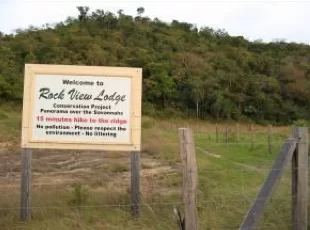 This forested hill near Rock View Lodge generated many excellent new birds for us
Day 8, Nov 24: We continued by 4×4, then by boat to Karanambu Ranch, where Giant Anteater is often seen but we dipped it. This lodge also hosts both tame (orphaned) and wild Giant River Otters. The place is full of herons, some of the better ones being Agami and Boat-billed Herons, both of which we found easily on a late afternoon boat trip, which also yielded Fishing Bats and Owl Moths. During the course of the afternoon, thanks to the excellent local guides, some members of the group quite easily found Bearded Tachuri in the savannah.
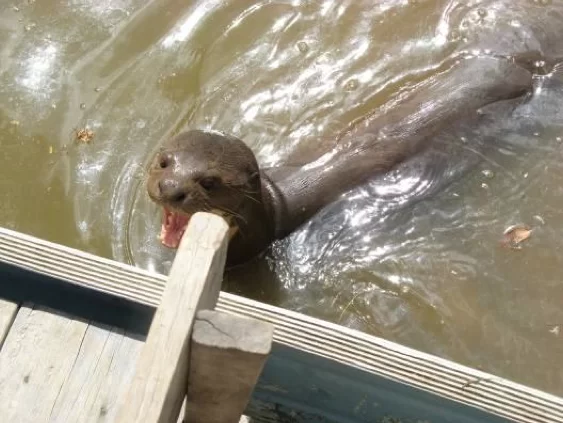 They told us this one was tame!
Day 9, Nov 25: This morning, highlights were Capuchinbird and the world’s largest water lily – Victoria amazonica (truly spectacular!), plus loads of more widespread stuff.
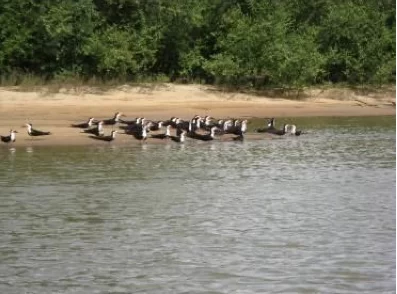 As usual, at Karanambu there were loads of relatively widespread birds such as these Black Skimmers along with a couple of really localized things…like Bearded Tachuri
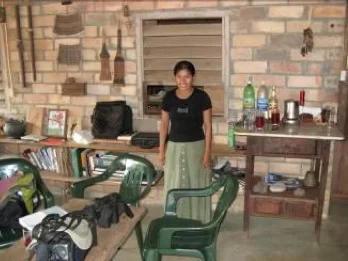 The staff at Karanambu were, as usual for Guyana, spectacularly helpful
After a final morning of birding, we caught our flight back to Georgetown, where we checked into another very comfortable hotel, Cara Lodge. At 4 pm, we had a very well-attended debriefing session where Tim Earl from the Travelling Naturalist presented the views of our group to our audience, which included the deputy minister of tourism, Guyanese tour operators and many other folk.
A fantastic dinner at the British High Commissioner’s Residence was followed by drinks back at the hotel followed by a nightclub visit by some of the group!
Day 10, Nov 25: We departed for Trinidad, where some of us were put up in a day use hotel which provided us with a few extra birds such as Magnificent Frigatebird, Brown Pelican, etc. before our evening flight to London and then home.
All in all, this was a truly splendid trip. Guyana is one of the last remaining great wildernesses on the planet. This reason alone makes it one of the most exciting countries to visit. There are few places left where such immense tracts of rainforest still carpet the earth’s surface. Almost everything about Guyana is poorly known, not least of which are the birds themselves. Relatively very few birders have visited this country, and so you have an excellent chance of finding new birds to add to the Guyana list, and maybe even new birds to science!
Another reason to bird Guyana is to support eco-tourism in this nation. As the world becomes more developed and greater demands are placed on natural resources by consumers, it is almost inevitable that Guyana’s wilderness will be put under increasing pressure from logging, etc. We believe that it is better for Guyana to develop strongly in the eco-tourism direction than in other ways, as this is the best way to ensure that its natural habitats get protected. Why not contribute by supporting the lodges and local birding guides being trained in Guyana by signing up for a birding trip here?
We plan to offer different kinds of birding trips to Guyana. Some will use only the more luxurious lodges, whereas others will be more adventurous. All our trips will have a marked focus on birding, especially on finding species difficult to locate elsewhere, such as many of the Guianan Shield endemics, but we will of course welcome sightings of Jaguar, other cats, etc., in this wild but incredibly friendly and welcoming country.